Mapping the Impact of User Feedback Loops on Iterative Design Processes in Portable Gaming Software
Written by Cameron Koch · Sep 24, 2026

Mapping the Impact of User Feedback Loops on Iterative Design Processes in Portable Gaming Software
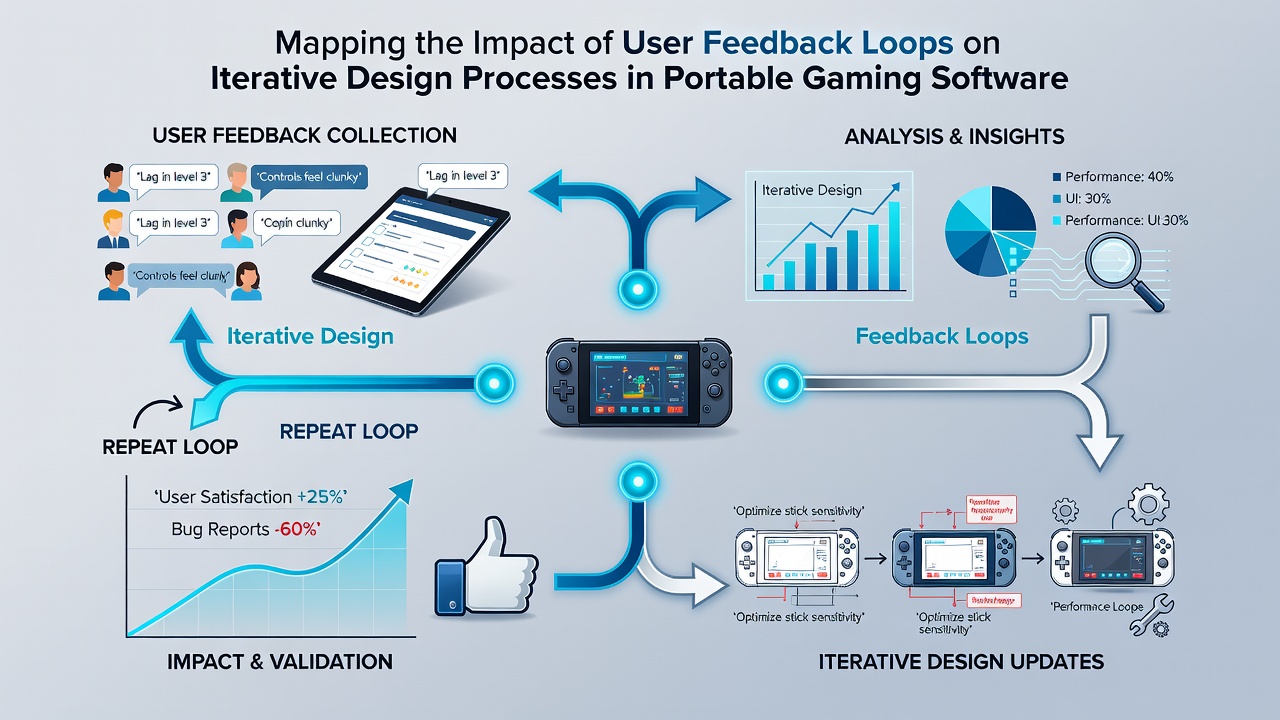
Portable gaming software relies on structured feedback systems that collect player input through in-app surveys, session analytics, and community forums, then route that data directly into design revisions. Teams track metrics such as completion rates, session duration, and feature usage before and after each update cycle, which allows developers to quantify how specific changes affect retention and engagement across Android and iOS platforms.
Data Collection Mechanisms in Mobile Environments
Developers integrate telemetry libraries that log player actions in real time while complying with regional privacy standards set by bodies like the European Data Protection Board. These systems capture patterns from thousands of daily sessions, then feed aggregated results into dashboards that highlight friction points such as tutorial drop-offs or level difficulty spikes. Research conducted by the International Game Developers Association shows that studios using automated tagging of feedback comments reduce manual review time by 40 percent compared with earlier manual sorting methods.
Survey prompts appear at natural breakpoints in gameplay, and response rates climb when questions stay under three items. Analysts cross-reference these qualitative replies with quantitative heatmaps generated from touch input data, which reveals whether players repeatedly tap the same unresponsive area. This combined view guides teams to adjust interface elements within the same sprint rather than waiting for the next major release.
Iterative Cycles and Version Control Integration
Design teams apply agile methodologies where each two-week sprint ends with a review of incoming feedback clusters. Version control repositories store both code commits and linked feedback tickets, so engineers can trace a particular menu redesign back to specific player complaints logged three iterations earlier. Data from a 2025 University of Waterloo study on mobile development pipelines indicates that projects maintaining this traceability achieve 25 percent fewer rollback incidents after public releases.
Automated testing suites run regression checks on modified modules before deployment to beta channels. Players enrolled in those channels receive builds that incorporate targeted fixes, and their subsequent play data determines whether the adjustment moves to the full user base. This closed loop shortens the interval between identifying an issue and confirming its resolution from months to weeks in many documented cases.
Regional Variations in Feedback Implementation
Studios operating across multiple markets adapt feedback prioritization according to local usage patterns. In markets with high data costs, teams place greater weight on offline functionality reports, whereas regions with widespread high-speed networks emphasize real-time multiplayer stability. A report released by the Canadian Interactive Digital Entertainment Association in September 2026 documented how Canadian developers shifted 15 percent of their iteration budget toward battery optimization after feedback volume on that topic doubled year-over-year.
Cross-border collaboration tools allow distributed teams to maintain a single source of truth for feedback items. Time-zone differences are managed through asynchronous comment threads attached to each ticket, ensuring that contributors in Asia, Europe, and North America review the same dataset before morning stand-ups in their respective locations.
Measurement of Design Impact
Key performance indicators include retention at day seven, average revenue per daily active user, and crash-free session percentages. Teams map these indicators against specific feedback categories using regression models that isolate the contribution of individual changes. Figures released by the Entertainment Software Association reveal that titles employing mapped feedback loops saw average day-seven retention rise from 18 percent to 27 percent between 2023 and 2025.
Qualitative sentiment scores derived from app store reviews provide an additional layer of validation. Natural language processing pipelines assign polarity values to thousands of reviews per week, then correlate shifts in those scores with deployment dates of targeted updates. When sentiment improves within a defined window after a revision, teams mark the corresponding feedback item as resolved and archive supporting evidence for future audits.
Conclusion
Mapping user feedback loops onto iterative design processes supplies portable gaming teams with traceable pathways from player observation to implemented change. Continued refinement of collection tools, integration with version control, and region-specific weighting of metrics supports consistent delivery of updates that align with documented player needs across global markets.