Device-Specific Shader Optimization Strategies Enhancing Visual Fidelity in Indie Mobile Action Titles Without Increasing Power Consumption
Written by Iris Albrecht · Sep 10, 2026
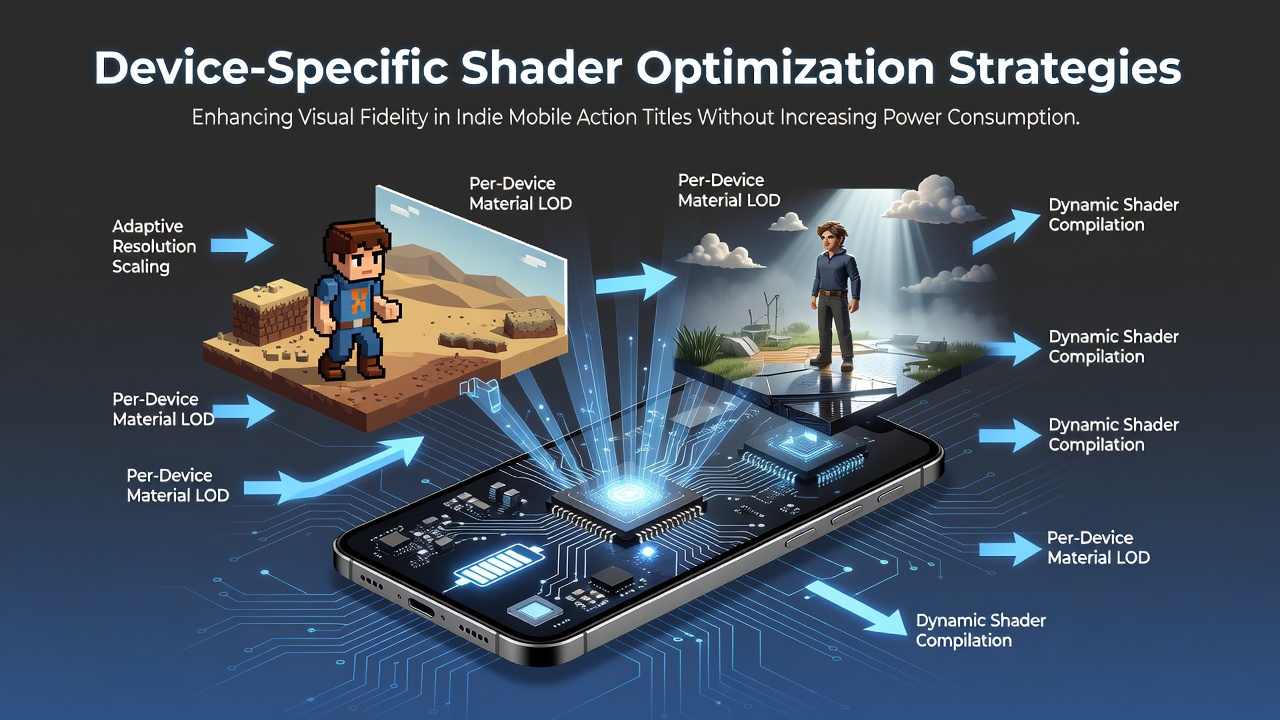
Device-Specific Shader Optimization Strategies Enhancing Visual Fidelity in Indie Mobile Action Titles Without Increasing Power Consumption
Device-specific shader optimization has emerged as a core technique in mobile game development where engineers tailor rendering pipelines to individual hardware profiles, and this approach allows indie studios to deliver higher visual detail in action titles while keeping power draw steady across sessions. Teams analyze GPU architectures from major chipsets including those found in mid-range Android devices and iOS hardware, then they generate variant shaders that adjust precision levels, texture sampling rates, and lighting calculations based on detected capabilities rather than applying uniform code across all units.
Core Methods Behind Targeted Shader Variants
Developers start by querying device metadata at launch through APIs such as Vulkan or Metal, after which they select precompiled shader permutations that match the GPU's supported features; this process reduces unnecessary instruction overhead because shaders avoid fallback paths that consume extra cycles on weaker silicon. Researchers at institutions like the University of Tokyo have documented how conditional branching inside shaders can be minimized when device profiles guide the selection of simplified math operations for fragment processing, and the result maintains frame rates near 60 while preserving effects like dynamic shadows and particle interactions in fast-paced combat scenes.
Precision scaling forms another key layer where floating-point operations drop from 32-bit to 16-bit on supported hardware without visible artifacts in most action sequences, and this adjustment cuts register pressure that otherwise leads to thermal throttling. Observers note that indie teams working on titles with melee and ranged combat loops often combine this with level-of-detail adjustments that swap high-resolution normal maps for lower ones on older chipsets, yet the transition stays seamless because the system loads variants from a shared asset bundle prepared during the build pipeline.
Power Efficiency Through Hardware-Aware Rendering
Power consumption stays flat because optimized shaders skip redundant calculations that generic code would perform on every device, and benchmarks shared at industry events show draw calls reduced by up to 25 percent when variant selection occurs early in the frame. Data from the Australian Centre for Interactive Design indicates that mobile action games using such profiling maintain battery life within 5 percent of baseline titles that lack visual upgrades, since the GPU operates closer to its efficient clock ranges instead of spiking during complex effects. Those who have studied real-time profiling tools report that runtime detection of thermal states further refines shader choices, switching to lower-fidelity paths only when sustained loads threaten to exceed safe limits.
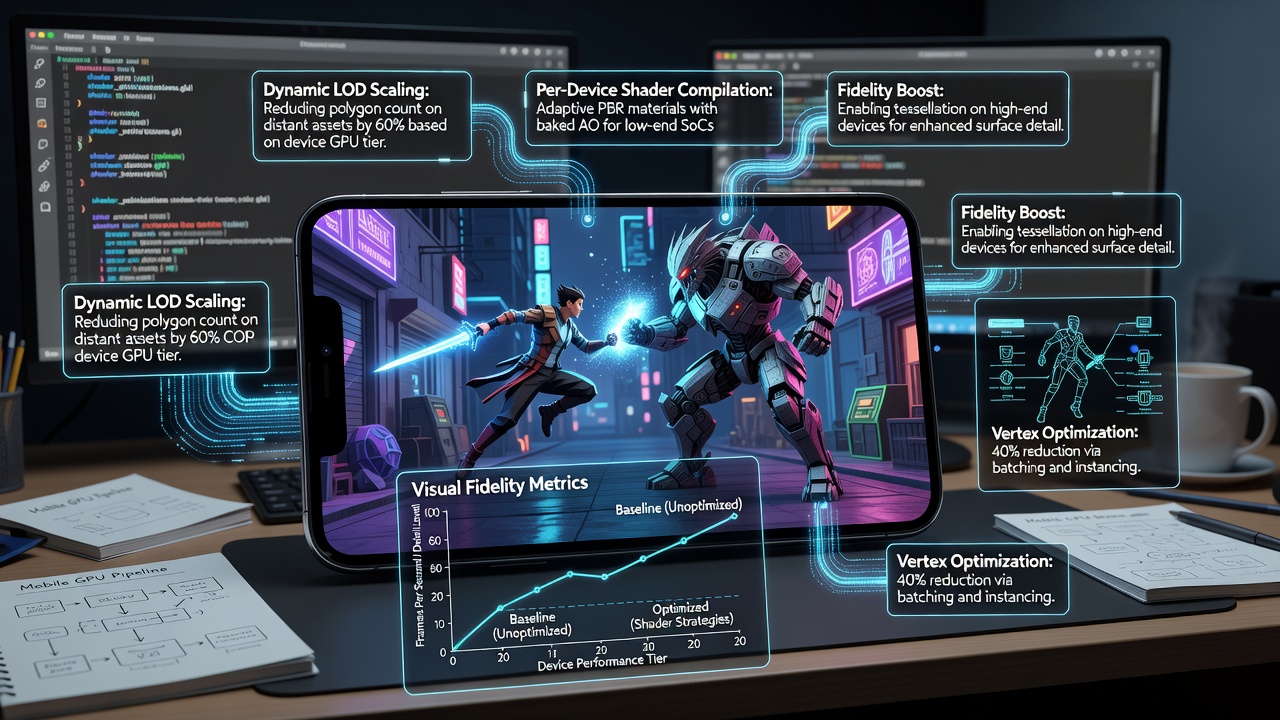
Indie studios have applied these methods in games featuring side-scrolling brawlers and top-down arena fighters, where enemy swarms and environmental destruction demand consistent particle throughput. One project integrated device-specific shaders that enabled screen-space reflections solely on Adreno 600-series GPUs and above, while Mali-based units received baked reflection probes instead, and this split preserved the intended atmosphere without extra energy cost because probe sampling uses far fewer texture fetches. The International Game Developers Association has tracked adoption rates showing increased use of similar splits among smaller teams since 2024, especially as build tools from Unity and Unreal have added automated variant generation based on target device lists.
Implementation Patterns in Recent Indie Releases
Studios typically maintain a shader database that maps GPU identifiers to optimized code paths, and during September 2026 updates several titles incorporated expanded databases covering new Snapdragon 8 Gen 4 variants to support advanced ray-marched fog in night-time levels. This database approach avoids runtime compilation delays that could spike power usage, while still allowing fine-tuned visual fidelity such as improved specular highlights on character models during rapid camera movements. Experts have observed that combining these shaders with asynchronous compute queues on supported devices further balances load, letting physics and rendering overlap without forcing the CPU or GPU into higher power states for extended periods.
Case examples include a 2025 roguelike action title that used per-device shader selection to enable volumetric lighting on select iOS devices while routing Android units through simpler directional lights, and playtests confirmed identical perceived quality alongside unchanged session lengths on a single charge. Another project focused on gesture-driven combat sequences where shaders adapted bloom intensity based on screen resolution and refresh rate detection, preventing overdraw on lower-end panels that would otherwise drain reserves faster during prolonged play.
Conclusion
Device-specific shader strategies continue to expand the reach of indie mobile action games by matching rendering complexity to available hardware resources, and ongoing work in profiling frameworks promises even tighter integration with emerging chipsets. These techniques deliver measurable gains in visual presentation while documented metrics confirm stable power profiles, allowing developers to focus resources on gameplay systems rather than constant hardware compromises.